The anatomy of a Claude prompt that works the first time
Most disappointing answers come from prompts that are missing one of five parts. Here is what each part does, with a before and after you can copy.
Give Claude your tasks, your fixed appointments and when you actually have energy, and get a week plan that puts hard work where you can do it.
Help me plan next week. I want the important work to land when I'm actually able to do it, not just wherever there's a gap.

Fixed things I can't move: [MEETINGS, SCHOOL RUNS, DEADLINES, WITH DAYS AND TIMES]
Tasks I need to get done, roughly in order of importance: [LIST THEM, WITH A TIME ESTIMATE IF YOU HAVE ONE]
When I do my best focused work: [e.g. mornings before 11, or late evenings]
When I'm useless: [e.g. right after lunch, Friday afternoons]
Other constraints: [e.g. no work after 6pm, gym three times a week]

What I'd like back:
- A day by day plan, morning and afternoon, with the fixed things in place and the tasks placed around them.
- Deep work in my good hours. Admin, email and easy tasks in the bad ones.
- Nothing longer than 90 minutes without a break, and at least one slot per day that's deliberately empty.
- If everything doesn't fit, tell me what to drop or move to the following week, rather than squeezing it in.
- One sentence per day on what a successful day looks like.
Everything fits except the conference talk outline, which I've pushed to the following week (see the note at the end).
Morning (your best hours) 8:30 to 10:00 write the Q4 proposal draft. 10:15 to 11:00 keep going, or stop if it's flowing and finish it.
Afternoon 13:00 standup. 14:00 to 15:00 expenses and inbox. 15:00 empty. 16:00 to 17:00 review Sam's pull request.
A good Monday: the proposal draft exists, even if it's rough.
Morning 8:30 to 10:00 proposal, second pass. 10:00 to 11:00 gym (you said three times a week, and Tuesday morning is free).
Afternoon 13:00 to 14:30 customer call prep, then the call at 15:00. 16:00 empty.
A good Tuesday: the customer call happens and you weren't preparing for it in a panic.
Morning 8:30 to 10:00 the data migration script, the hardest task left. 10:15 to 11:00 continue.
Afternoon 13:00 to 14:00 inbox. 14:00 to 15:00 school run and back. 15:00 to 16:30 finish the migration script or write down where you stopped.
A good Wednesday: the migration script runs against test data.
Morning 8:30 to 10:00 gym, then 10:15 to 11:30 proposal, final read and send.
Afternoon 13:00 to 14:30 team planning meeting. 15:00 empty. 16:00 to 17:00 one-to-ones.
A good Thursday: the proposal is sent.
Morning 8:30 to 10:00 gym. 10:15 to 11:30 tidy up the migration script and open the pull request.
Afternoon You said Friday afternoons are dead time, so: inbox to zero, timesheet, and a 20 minute note on next week. Nothing else.
A good Friday: you leave at 5 with nothing hanging over the weekend.
The conference talk outline (2 hours of real thinking). Your good hours are full with the proposal and the migration. Rather than doing it badly on Friday afternoon, I'd put it first thing Monday next week.
NoteThis is an example. Results change between runs and model versions. Claude Prompts is a fan project and is not affiliated with Anthropic.
Anyone whose week fills up with meetings and then wonders where the real work went. It works especially well if you know your own rhythm and keep ignoring it.
The "when I'm useless" line is the one most people skip, and it's the one that makes the plan work. Put in the real times. If you estimate tasks, estimate generously, because the plan will only be as realistic as the numbers you give it. The "what to drop" rule is there so you get a plan you can actually follow, not a wish list.
Nobody follows a plan to the minute. The value is in the placement: hard things in good hours, admin in bad ones, some empty space so a surprise doesn't wreck the day. Adjust it on Sunday night, then stop editing and go to bed.
Use the copy button above. The full text is included, nothing is cut off.
Everything highlighted in yellow is a placeholder. Swap it for your own topic, audience or data.
If the result helped, press the heart. Votes decide which prompts make the weekly top 10.
Prices Fact Detail Source Unit price EUR 4.20 per unit for the first 10,000 units Section 3.1, "Pricing" Volume discount EUR 3.85 per unit above 10,000 units in a calendar year Section 3.1, "Pricing" Setup fee EUR 1,500...
Turn a long report, contract or transcript into a structured list of facts, numbers and dates, each with a pointer back to where it came from.
Summary. The launch moves from 2 October to 9 October so the checkout bug can be fixed properly. Marketing keeps the original date for the teaser email. Decisions Launch day is now 9 October. The teaser email still goes out on...
Turn messy notes or a transcript into decisions, a task table with owners and dates, the open questions, and a message for the team channel.
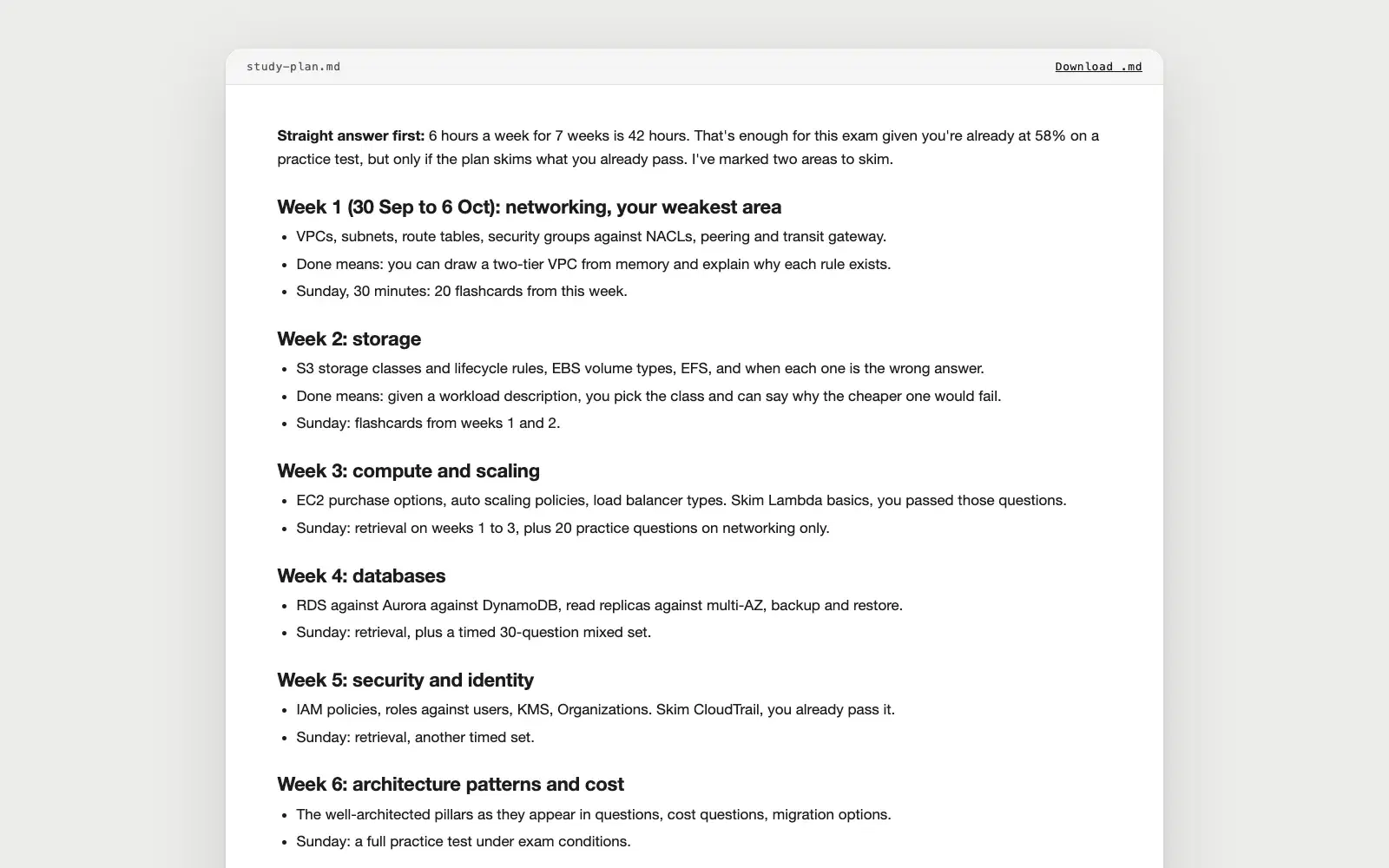
Tell Claude the exam, the date and what you already know, and get a week by week plan that puts your weakest topics first and keeps the last days for practice tests, not new material.
Most disappointing answers come from prompts that are missing one of five parts. Here is what each part does, with a before and after you can copy.
One vote per prompt, a fresh count every Monday, and a simple tie-break. Everything about how prompts reach the top three, in plain words.